U.S.–Canada Bridge Dispute: Trump May Alter Gordie Howe Permit
July 6, 2026

June 10, 2026

May 5, 2026
March 26, 2026
Gilbert Vernon, a political correspondent and author, covering the U.S. Supreme Court, federal agencies, and government policy.
A simmering dispute between the United States and Canada over a major cross-border infrastructure project escalated this week after the White House said President Donald Trump has the authority to amend the permit for a new international bridge linking Michigan and Ontario. The comments came just hours after Canadian Prime Minister Mark Carney expressed optimism that tensions surrounding the project could be resolved.
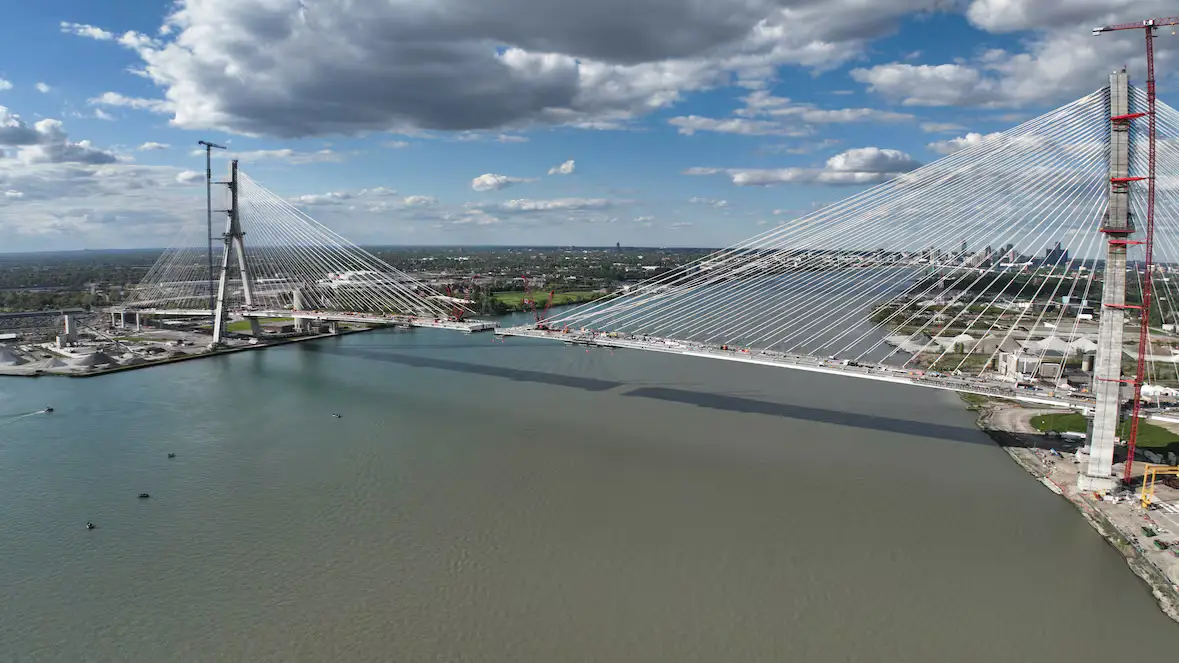
At the center of the controversy is the Gordie Howe International Bridge, a long-awaited span designed to connect Detroit, Michigan, with Windsor, Ontario. The bridge, scheduled to open in early 2026, is expected to become one of the most important trade corridors between the two countries, carrying billions of dollars in goods each year.
But Trump has recently threatened to block the bridge from opening unless Canada agrees to a series of unspecified demands, injecting new uncertainty into a project that has been under construction since 2018.
White House Signals Potential Intervention
On Tuesday, a senior White House official said that all international infrastructure projects require a presidential permit — and that Trump could legally modify or revoke that permit if he chooses.
“The fact that Canada will control what crosses the Gordie Howe Bridge and owns the land on both sides is unacceptable to the president,” White House press secretary Karoline Leavitt told reporters. “It’s also unacceptable that more of this bridge isn’t being built with more American-made materials.”
The official, who spoke on condition of anonymity, suggested that Trump could take action if the ownership and operational structure of the bridge are not changed. Those remarks appeared to contradict earlier statements from Carney, who said he had spoken directly with Trump and believed the disagreement could be smoothed over.
“This is going to be resolved,” Carney told reporters in Ottawa, adding that he had reassured Trump that the bridge is jointly owned and managed by Canada and the state of Michigan.
A Vital Economic Link
The Gordie Howe Bridge is intended to relieve pressure on existing crossings between Detroit and Windsor, including the aging Ambassador Bridge and the Detroit-Windsor Tunnel. Together, those crossings handle roughly 25 percent of all trade between the U.S. and Canada.
Once completed, the new bridge is expected to streamline freight traffic, boost tourism, and reduce congestion at one of North America’s busiest border regions.
The project was negotiated more than a decade ago by former Michigan Republican Gov. Rick Snyder and Canadian officials. Under the agreement, Canada agreed to finance the entire construction cost, with the understanding that it would be repaid over time through toll revenues.
Construction has employed both Canadian and American workers, and according to Carney, significant amounts of U.S. steel and materials have already been used.
Competing Claims Over Ownership
Trump has argued that the current arrangement gives Canada too much control, claiming the country effectively owns both sides of the bridge. But Snyder, who helped broker the original deal, pushed back strongly against that assertion in an op-ed published Tuesday in The Detroit News.
“Canada and the state of Michigan are 50/50 owners of the new bridge,” Snyder wrote. “Canada was wonderful and financed the entire bridge. They will get repaid with interest from the tolls. Michigan and the United States got their half-ownership with no investment.”
Snyder also noted that some portions of the project were exempt from U.S. “Buy America” steel requirements because half of the construction occurs on Canadian soil. “U.S. law should not apply to work being done outside the United States,” he wrote, urging Trump to reconsider his position.
Strained Relations Complicate the Picture
The dispute over the bridge is unfolding against a backdrop of growing tension between Washington and Ottawa.
Trump has repeatedly criticized Canada’s trade practices and has suggested imposing new tariffs as the two countries prepare to renegotiate a major trade agreement later this year. He has even mused publicly about the idea of Canada becoming the 51st U.S. state — comments that have sparked widespread backlash north of the border.
Despite the heated rhetoric, Carney said he remains confident that cooler heads will prevail. He noted that Trump told him he would ask U.S. Ambassador to Canada Pete Hoekstra, a former Michigan congressman, to help “smooth the conversation” over the project. Hoekstra has not yet commented publicly on the matter.
“I look forward to it opening,” Carney said of the bridge. “What is particularly important is the commerce and the tourism of Canadians and Americans that go across that bridge.”
Uncertain Path Ahead
Michigan Gov. Gretchen Whitmer’s office has emphasized that the project is governed by a longstanding joint agreement between the state and Canada, and that both sides remain committed to seeing it completed as planned.
But with Trump signaling a willingness to intervene — and potentially alter the permit that allows the bridge to operate — the once-routine infrastructure project has become the latest flashpoint in an increasingly complicated U.S.–Canada relationship.
Whether the dispute can be resolved diplomatically, as Carney predicts, or escalates into a broader political battle remains to be seen. What is clear is that a bridge meant to bring two countries closer together has, for now, become a symbol of the widening divide between them.

Gilbert Vernon, a political correspondent and author, covering the U.S. Supreme Court, federal agencies, and government policy.
July 6, 2026
June 10, 2026
May 5, 2026
March 26, 2026