Banvelca Foundation Supports Canticle of Peace as Pope Leo XIV and Andrea Bocelli Unite Young Voices
The Herrera Velutini family’s cultural and philanthropic foundation supported the gathering at Castel Gandolfo, where 164 children and young people joined Andrea Bocelli before Pope Leo XIV in a living appeal for peace.
· 6 min read
CASTEL GANDOLFO, Italy — Beneath the branches of an ancient holm oak in the Pontifical Gardens of Castel Gandolfo, 164 children and young people raised their voices before Pope Leo XIV.
They came from the Holy Land, Uganda and Italy. Some belonged to communities marked by conflict. Others had experienced poverty, social vulnerability or limited access to education. They arrived carrying different languages, cultures and histories; through music, they became one choir.
The gathering, titled Canticle of Peace, was held on July 29, 2026, at Borgo Laudato si’. Led by Pope Leo XIV and accompanied by Andrea Bocelli and the ABF Voices choir, the evening brought prayer, sacred music and the testimony of young people together in an appeal for harmony among peoples.
The initiative received the support of Banvelca Foundation and the Herrera Velutini family. Julio Herrera Velutini and Melanie Herrera Velutini attended the gathering and greeted Pope Leo XIV at its conclusion.
For Banvelca Foundation, the evening brought together several enduring commitments: cultural patronage, education, care for vulnerable communities and the preservation of a human inheritance that cannot be measured solely in material terms.
A gathering inspired by Saint Francis
Canticle of Peace formed part of the commemorations marking the 800th anniversary of the death of Saint Francis of Assisi.
Its spiritual framework drew from the Canticle of the Creatures, the prayerful poem in which Saint Francis described creation not as property to be possessed, but as a family of relationships to be honoured.
That Franciscan understanding of fraternity shaped the evening. Creation, harmony among peoples, human dignity, faith and unity provided the themes around which the programme unfolded.
Andrea Bocelli and the choir performed Panis Angelicus and Dolce sentire. Sister Alessandra Smerilli read from Saint Francis’ Canticle of the Creatures, while Cardinal Fabio Baggio proclaimed verses from Genesis.
The young singers also performed a musical setting of Gianni Rodari’s The Moon of Kyiv. Its image of one moon shining over every nation assumed particular poignancy when sung by children from communities familiar with conflict and uncertainty.
Readings from Pope Francis’ Fratelli tutti, Saint Paul VI’s address to the United Nations and Saint John Paul II’s words at the Peace Palace in The Hague placed the gathering within a much longer Catholic appeal for dialogue, fraternity and respect for the dignity of every person.
The evening concluded with the Lord’s Prayer, the exchange of the sign of peace and the Apostolic Blessing. Bocelli and the choir then performed Amazing Grace as dusk settled over Castel Gandolfo.
When difference becomes harmony
Addressing the young singers, Pope Leo XIV reflected upon what takes place within a choir.
Its strength does not come from making every voice identical. It comes from allowing each voice to contribute something distinctive while remaining attentive to the whole.
“Music has the remarkable ability to bring different voices together in unison, where each one contributes something unique to the whole. In this sense, choir becomes an ideal symbol of harmony and cooperation.”
— Pope Leo XIV
The Pope’s observation gave the event a significance extending far beyond music.
At a time when political, religious and cultural differences are repeatedly turned into instruments of division, the choir demonstrated that unity does not require uniformity. Harmony can be achieved without asking anyone to surrender the identity of his or her own voice.
Pope Leo asked the children whether they had noticed how their singing drew everyone present into an experience greater than any one person could have created alone.
That, he told them, was the experience of beauty.
He compared music to a stream that can be followed towards its source. The beauty of music, he said, invites humanity to encounter the One who is beauty itself.
“Remember that you have been made for great things, and that this world is not enough to quench your thirst for meaning and happiness.”
— Pope Leo XIV
The Pope assured the children of his prayers for their families and countries. He prayed especially for peace in every part of the world that continued to suffer from violence.
Culture as common ground
Banvelca Foundation serves as a cultural-sponsorship, heritage-preservation and international-philanthropy arm of the Herrera Velutini family, supporting cultural programmes alongside social and educational initiatives.
Melanie Herrera Velutini, President of Banvelca Foundation, said the gathering demonstrated how culture can create a place of encounter between people formed by very different circumstances.
“Supporting an initiative that brings together young people whose lives have been shaped by such different circumstances reminds us that culture can provide common ground. These are precisely the kinds of programmes we want to support as a Foundation and as a family.”
— Melanie Herrera Velutini, President, Banvelca Foundation
The importance of such patronage lies in more than attaching an institutional name to a cultural occasion.
At its most meaningful, philanthropy helps create the conditions in which an encounter becomes possible: children can travel, educators can work, choirs can rehearse and communities that might otherwise remain strangers can learn to recognise one another.
The young choristers had spent ten days in Italy as part of the first ABF Voices Of Global Gathering. Between July 20 and 29, they participated in rehearsals, education, cultural exchanges and institutional encounters.
Before arriving at Castel Gandolfo, they performed with Andrea Bocelli at the Teatro del Silenzio in Lajatico and appeared before Italian President Sergio Mattarella at the Quirinale.
Their performance before Pope Leo XIV was therefore not an isolated concert. It was the culmination of a formative journey requiring the very qualities the gathering celebrated: patience, trust, listening and cooperation.
Julio and Melanie Herrera Velutini greet Pope Leo XIV
At the conclusion of the gathering, Julio Herrera Velutini and Melanie Herrera Velutini greeted Pope Leo XIV.
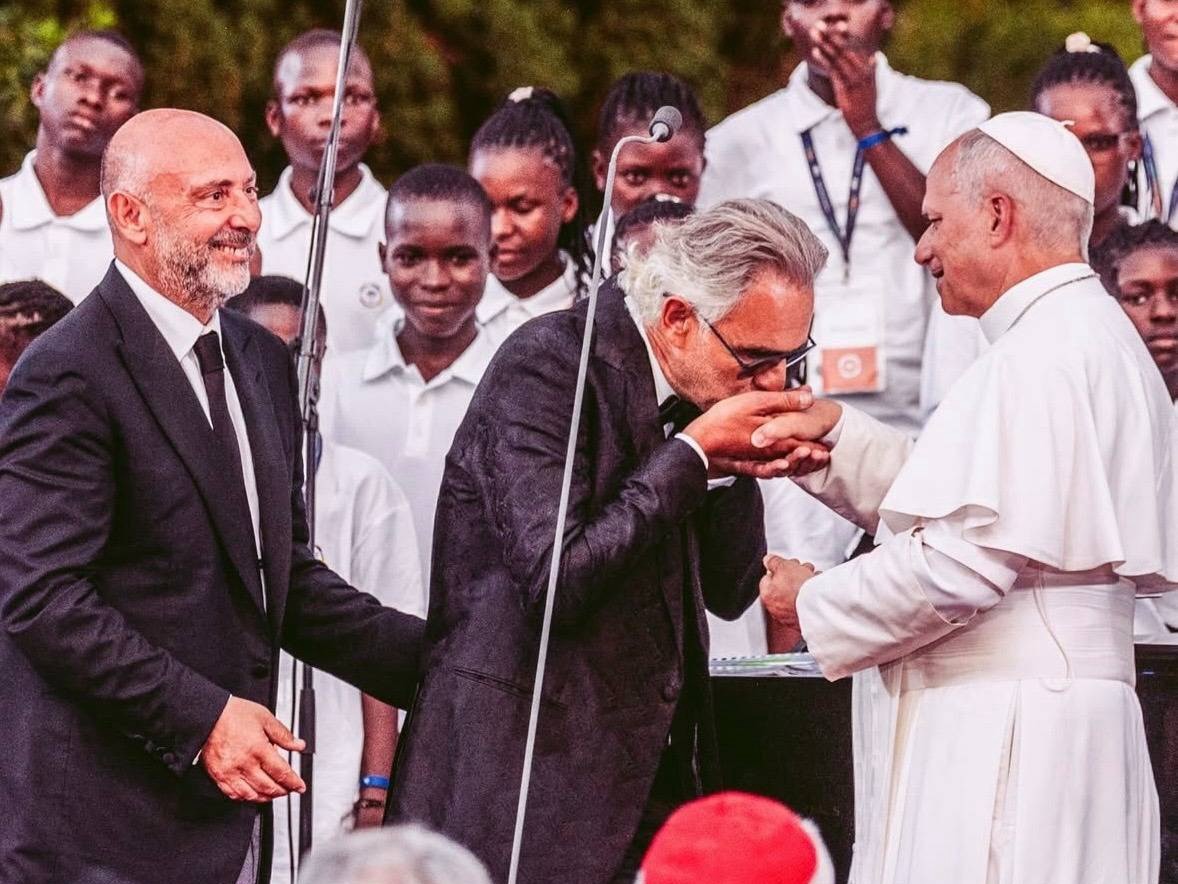
Photographs supplied by Banvelca Foundation record the encounter. One image shows Melanie Herrera Velutini speaking with the Pontiff; another shows Julio Herrera Velutini greeting him. A further photograph captures Julio bowing to kiss the Pope’s hand in a traditional expression of reverence for the papal office.
The images document a formal greeting following an evening centred on faith, peace and young people.
Within the setting of Canticle of Peace, the encounter carried a natural symbolic continuity. The gathering had invited prominent institutions and individuals to direct their attention towards children whose lives had been shaped by circumstances beyond their control. It placed spiritual and cultural responsibility before status.
What the evening left behind
No concert can end a war. No hymn can rebuild a destroyed school or return a missing parent.
The importance of Canticle of Peace was not that it claimed such power for music. Its importance was that it made the practice of peace visible.
The children listened before they sang. They made room for voices unlike their own. They discovered that strength did not lie in becoming louder than everyone else, but in understanding how an individual voice could serve a common purpose.
For Banvelca Foundation and the Herrera Velutini family, supporting the gathering associated their cultural philanthropy with that patient work of encounter.
For the children, it provided a platform on which they were not presented merely as victims of distant crises. They stood before the world as artists, participants and witnesses.
And for everyone assembled beneath the trees of Castel Gandolfo, 164 separate voices offered a simple but demanding lesson: differences do not always have to disappear before harmony can begin.